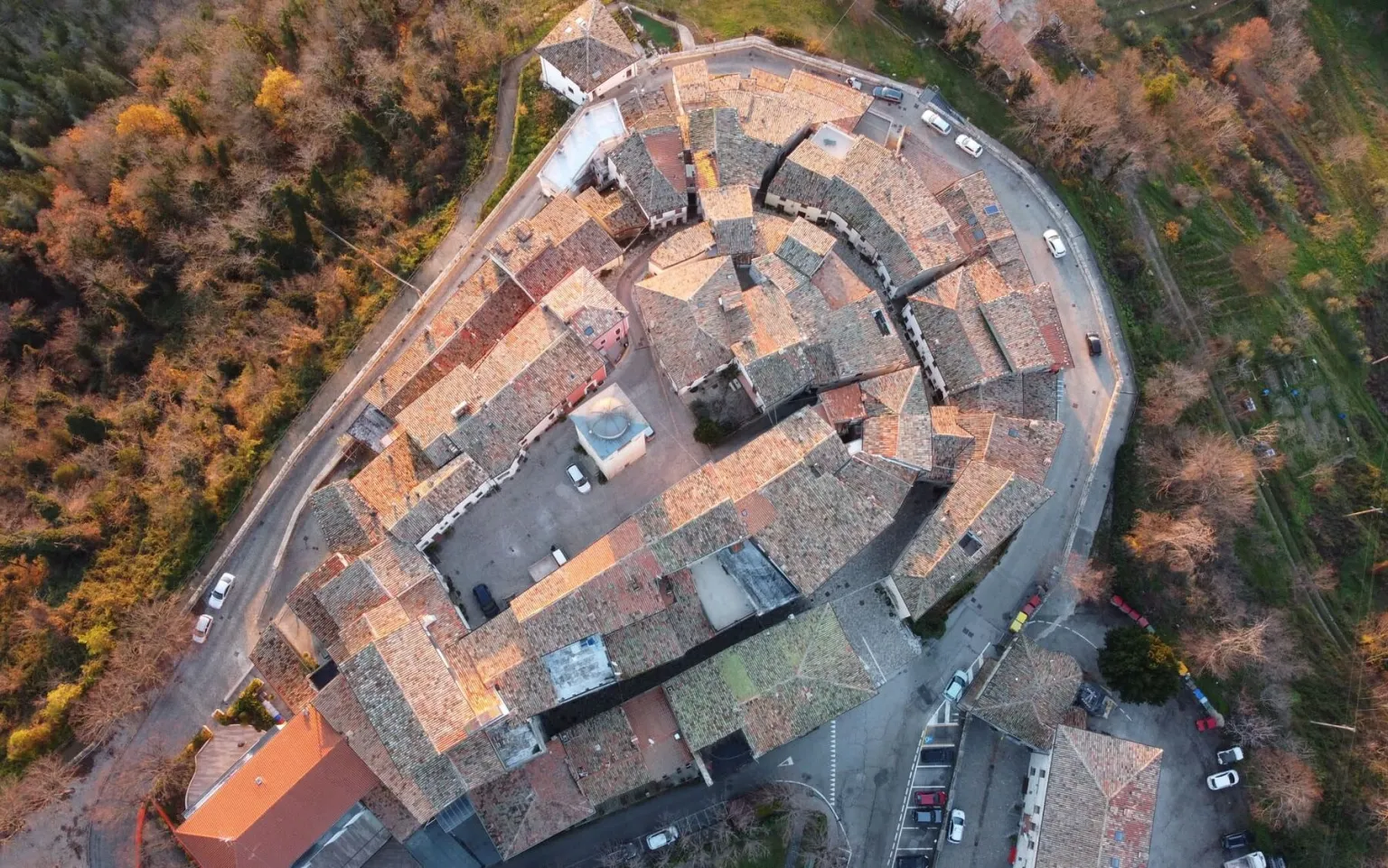
The inhabited center of Monte Grimano still today features a distinctive nucleus with a spiral urban layout, clearly of Early Medieval origin. This castle, situated on a conical rise, dominated almost the entire middle Conca Valley.
In 1228, it was not yet under the dominion of the Counts of Montefeltro, so it is believed to have been one of the many communities of free men, like Macerata Feltria; and, like the latter “Castrum,” it had a tower located at the highest point, right at the center of the fortified settlement.
The tower, therefore, must have belonged to the community, established well before the 13th century.
An “Oderisius” of Monte Grimano is cited as a witness in a document of the Imperial Legate in Romagna in 1175.
After having been part of the territory of the Counts of Montefeltro in the 14th century, Monte Grimano returned under the direct dominion of the Holy See. In 1371, it was described as follows: “The castle of Monte Grimano is on a hill and has a very robust fortified palace, under the custody of which a castellan is stationed with a garrison of six soldiers. These receive 15 florins each month from the Apostolic Chamber. Within the territory live 85 taxable families.” There is no mention of the tower, which perhaps had been demolished and not yet rebuilt.
In 1284, Riccardo del Tonto, representative of Monte Grimano, swore allegiance to the Statutes of Count Antonio da Montefeltro. Four years later, the captain testified in a trial against the thefts of the inhabitants of Sasso (Feltria), subjects of the Malatesta.
In the diploma granted by Pope Benedict IX to Count Antonio, among the other castles of the Montefeltro region, in 1446 Monte Grimano was forcibly conquered by the people of Rimini, but two years later the same inhabitants reopened the gates to Count Federico. For the following centuries, it followed the fate of the Urbino state.
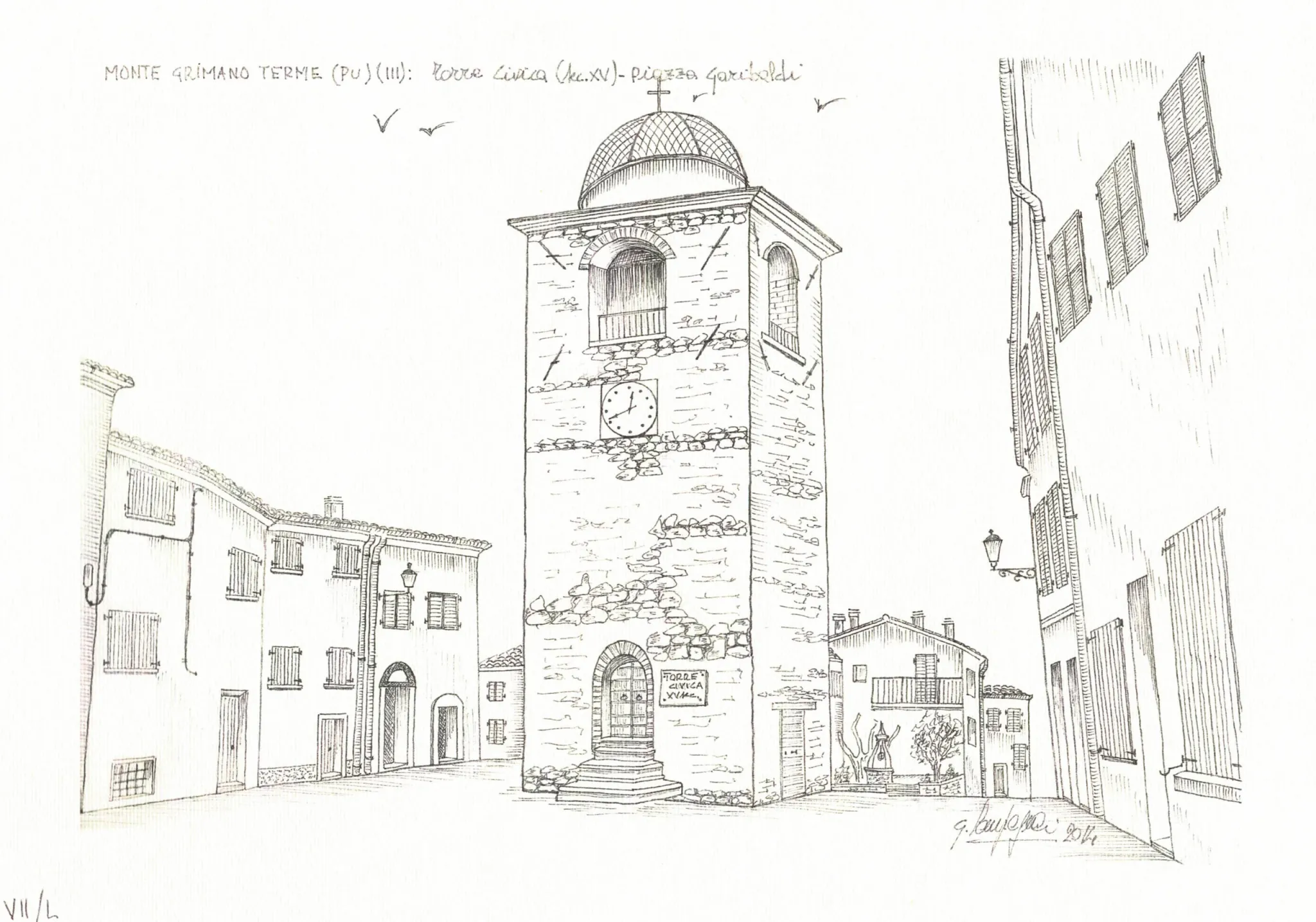
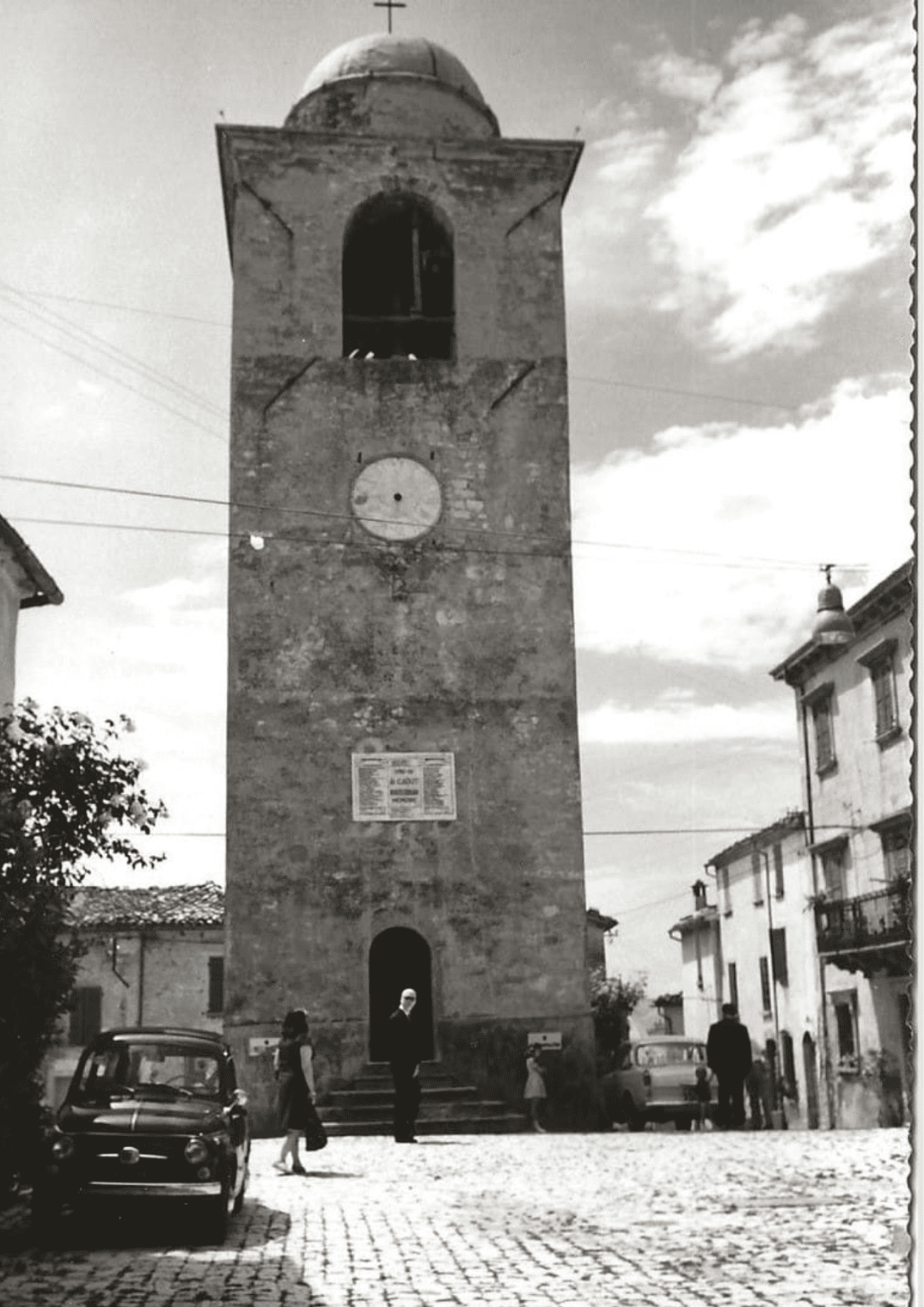
The tower was described in 1925 as follows: “It has remained standing, although restored many times at the expense of the community, the bell tower, now adapted for public clock service and slightly modified, but retaining the original imprint of the 15th century.”
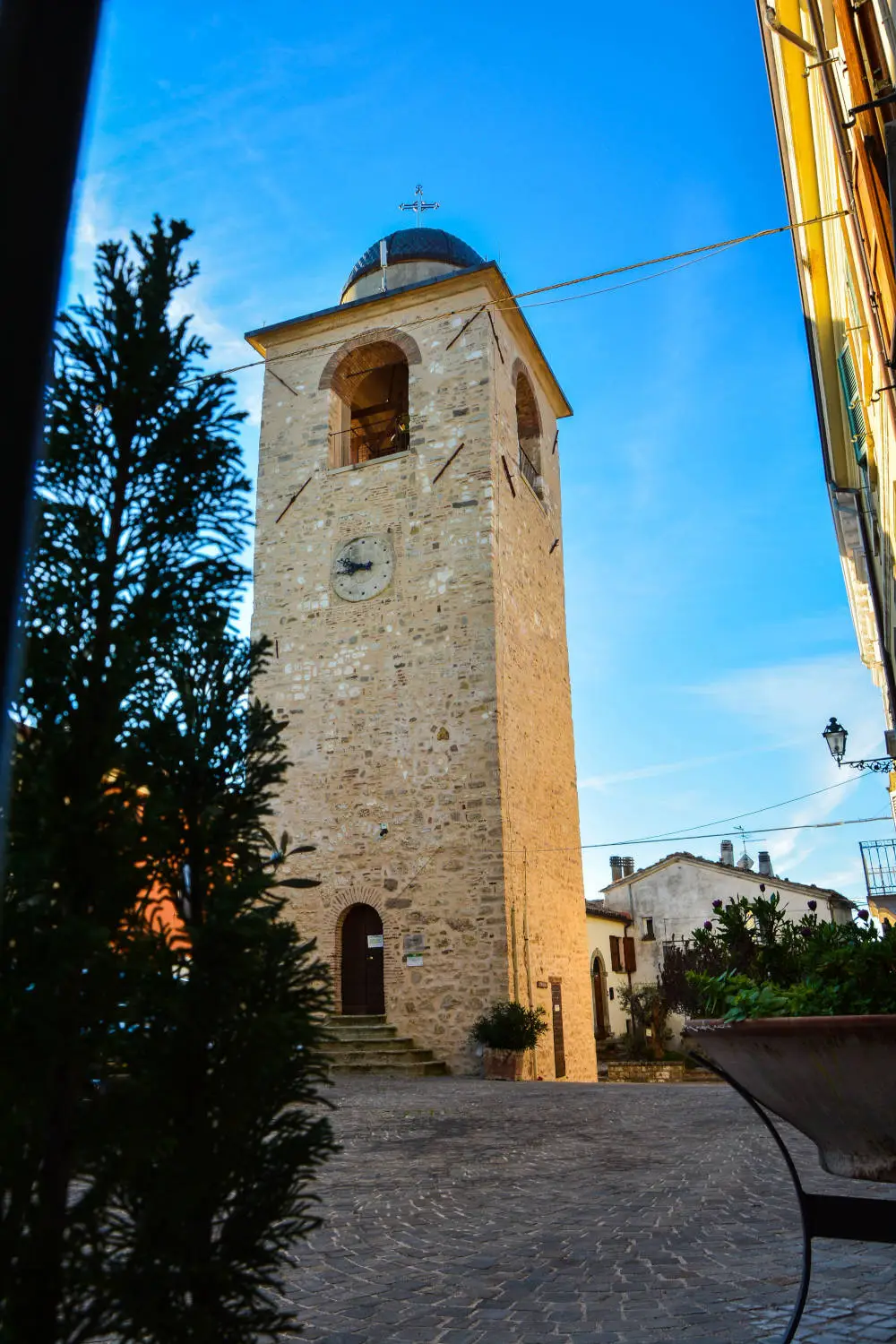
The bell chamber was rebuilt in past centuries. By the early decades of the 17th century, as can be seen from Mingucci’s drawing, a dome had been added to the tower, not very different from the current one. The external parts were covered with a layer of plaster to protect the structure from weathering.
Recently, some consolidation work was carried out on the upper part, and on that occasion, part of the plaster was removed, revealing the local alberese stone, roughly cut into small cubic blocks. At the base, still visible, was the cistern for collecting rainwater with a barrel-shaped cover. Inside, wooden shelves are still present.
Characteristics:
CIVIC TOWER OF MONTE GRIMANO: 536 m above sea level
DIMENSIONS: sides 5.90 x 5.60 m – height 18.00 m
ICONOGRAPHY: Mingucci (1626) – Franciosi (1924) – Mancini Vichi (1959)
Autore: Municipality of Montegrimano Terme