Monte Grimano, today a small spa and tourist center in the Val Conca, in the province of Pesaro and Urbino, located on a hill on the left bank of the Conca River at 536 meters above sea level, held considerable importance, especially during the early and late Middle Ages.
Text by Professor Antonio Di Stefano – All rights reserved
The interest in this location was mainly due to its elevated position, right on the edge of the main valley, making it easily accessible while also offering effective defense and significant control over potential invaders.
Presumably already in Roman times, and later throughout the Middle Ages, the area was frequented as a “place of rest” and vacation spot by those living in towns along the coast or cultivating the plains near the sea, from Cattolica (ancient Crustumium?) to Rimini.
The first document of ‘Mons Germanus
The medieval name of this castle of the Montefeltro was Mons Germanus. Under this name, it is mentioned in a diploma dated from Viterbo, August 16, 962, in which Emperor Otto I granted it as a fief, along with other castles of the Montefeltro, to Uldarico of Carpegna for having helped him, during the siege of San Leo, to fight Berengar II, who had proclaimed himself king of the Italian Kingdom and had taken refuge in this impregnable fortress after the fall of Pavia (961).
Along with Monte Grimano, i.e., Mons Germanus as it is called in the Investiture Diploma, the fief also included Monte Tassi, San Marino, and Pietracuta.
Having become part of the domain of the Counts of Carpegna, Monte Grimano experienced a long period of relative administrative stability and tranquility in agricultural and livestock activities.
The First Medieval Fortress
It was precisely Nolfo da Carpegna, son of Uldarico, who had the first medieval fortress built: a substantial building within a large courtyard, surrounded by strong walls with a single gate facing north, encircled by a moat, and equipped with a tower serving as a watchpoint.
The nearly elliptical perimeter of the walls covered an area of about two hectares, with a convex surface slightly sloping toward the north.
The fortress included a semi-circular tower extending on the west side outside the walls, purely for defensive purposes.
A cistern collected rainwater, while rooms were dedicated to storing weapons. The village, characterized by large buildings arranged along the inner perimeter (it was forbidden to attach constructions to the outer side of the walls according to military safety rules) and enriched with small and limited loopholes, formed the essential elements of this first settlement with urban features.
A castellan and some officers occupied the central part of the fortress, while families, called “fires” (fuochi), lived in the village within the walls. Very few houses existed in the surrounding countryside.
In the 12th century, with the advent of the imperial crown under Frederick I of Swabia, Montefeltro was granted in fief to Count Antonio of Carpegna, from the Monte Copiolo branch. From then on, the lords of Monte Copiolo took the more honorable title of Counts of Montefeltro, later becoming Counts of Urbino and eventually Dukes. The name Mons Grimanus, from which the current toponym “Monte Grimano” derives, appears for the first time in 1296 in a document concerning the liberties of San Marino, signed by a local notary, a certain “Ulderisius de Monte Grimano, imperiali auctoritate notarius.”
During these years, the original fortress of Monte Grimano underwent significant transformations, earning the designation “Castrum Montis Grimani.”
In 1358, after the restoration of Papal power under Cardinal Egidio Albornoz, the “Romandiola Feltresca” was administratively divided into five districts (podesterie), and Monte Grimano became part of one alongside Macerata Feltria, Montecerignone, Pennabilli, and San Leo. It should be noted that at the time the pope resided in Avignon, and one of the conditions for the hoped-for return to Rome was the reorganization of the ancient Papal States.
The fact that Monte Grimano is mentioned alongside other, better-known localities sufficiently demonstrates the importance this castle held in the late Middle Ages.
Cardinal Anglic Grimoard de Grisac recalled it as:
“Castrum Montis Grimani est in quodam Monte, quoad habet Palatium valde forte, ad cuius custodiam moratur unus Castellanus cum sex paghis (…) In quo sunt focularia 85. Villa Meleti in qua sunt Focularia quattuor”
—that is, a castle that had become wealthy and strategically strong, with six paid guards in charge of its defense.
There were as many as 85 “fires”
Thus, by the end of the 14th century, Monte Grimano no longer had just a primitive fortress but a very strong palace — a true fortress. Within the castle and its immediate surroundings, there were 85 “fires” (households) and four in the nearby settlement of Villa Meleti, an agglomeration, Meleto, which still exists today.
If we consider that in the neighboring castles of Montefiore, Saludecio, Montescudo, and Gemmano — all located further down the valley — the population barely exceeded a hundred fuochi, and that Montecerignone, considered from the Middle Ages until the unification of Italy the most important center of the Montefeltro area in the Conca Valley, hosted only 70 fuochi, the significance of Monte Grimano’s population becomes clear.
Taking into account that each fuoco represented a family unit that included grandparents, parents, children, grandchildren, other cohabiting relatives, and various servants, the population of Monte Grimano at that time was truly substantial. It could have been around 800–900 people in the castle alone, not counting the “subject” communities of Monte Tassi and Ripalta — when, for example, Ancona had fewer than ten thousand inhabitants!
If we also accept the hypothesis that only taxable fuochi were counted due to their wealth, it can be assumed that the inhabitants’ activities were no longer limited to agriculture, livestock farming, and the presence of a few military personnel and bureaucrats, but that other artisanal and commercial activities had developed.
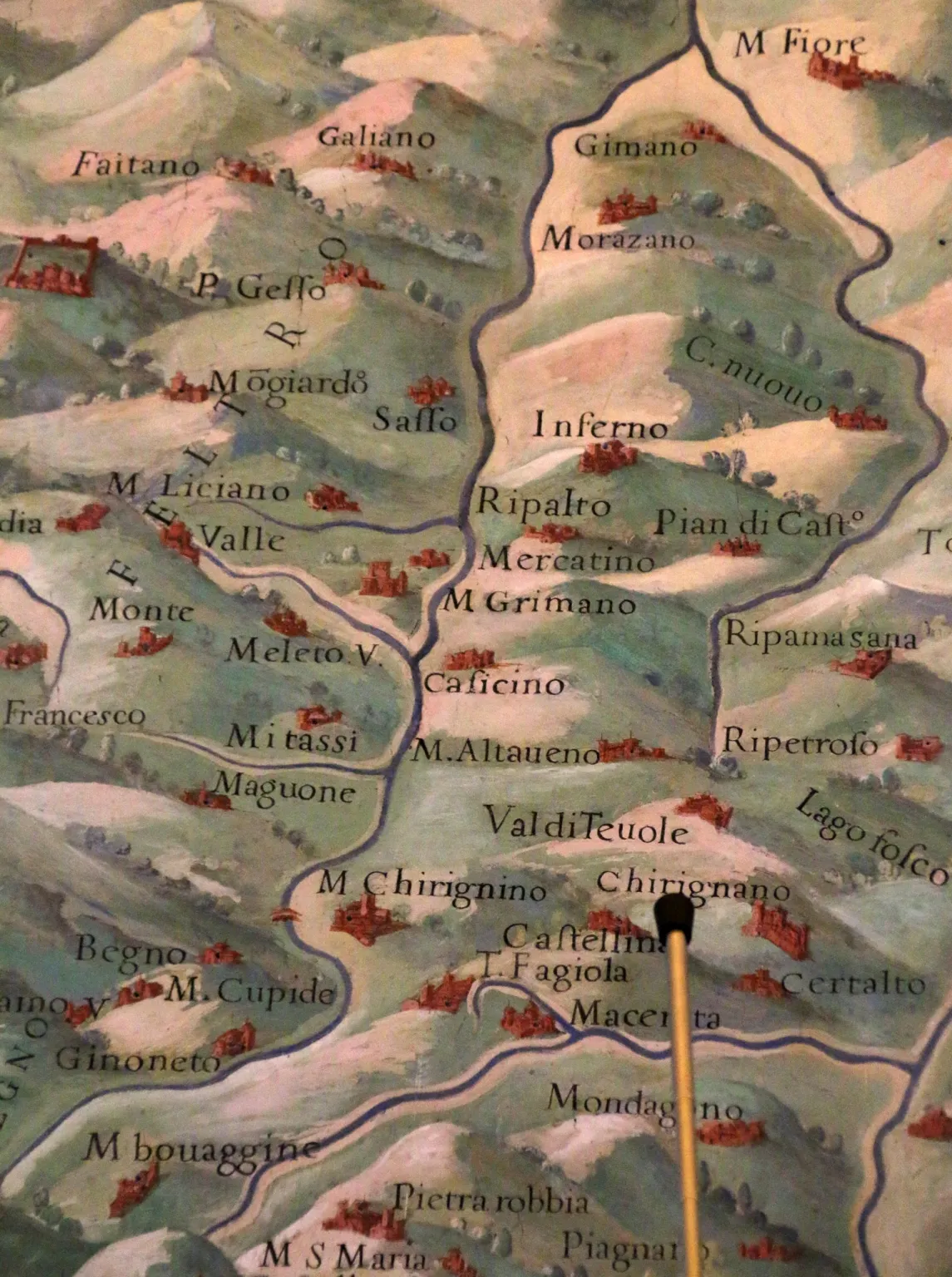
In 1390, the fortress of Monte Grimano, along with 33 other castles in the Montefeltro area, was recognized by Pope Boniface IX as belonging to the ancient House of Montefeltro, in particular to Antonio, who had previously already obtained the cities of Urbino, Cagli, and Sant’Angelo in Vado. Monte Grimano became important for the Montefeltro because the territory under their authority — even if sometimes contested by the Malatesta of Rimini — also included Montescudo, Sassofeltrio, and, on the hills of the opposite side of the Conca, Pian di Castello and even Montealtavelio.
The battles between the Malatesta and the Montefeltro that destroyed Monte Grimano
At the end of the 14th century and throughout the first half of the following century, the ancient feudal dominion of the Lords of Urbino and those of Rimini transformed into a signorial power, to which some smaller communities eventually subordinated themselves in search of protection and stability against external hegemonic claims. With the papal investiture, the Montefeltro of Urbino acquired their own “regional state,” committing themselves to defend it from any invasion, personally engaging in wars, expanding it through successive conquests, and administering it during times of peace.
The presence in these lands, between Umbria and Romagna, of two powerful families such as the Malatesta and the Montefeltro made the outbreak of repeated conflicts inevitable, in which Monte Grimano was often directly involved.
In the summer of 1446, Sigismondo Malatesta laid siege to and occupied Monte Grimano, reducing the fortress almost entirely to ruins. The same fate had already befallen the castles of Montecerignone, Monte Tassi, Valle Sant’Anastasio, Montecopiolo, and Pietrarubbia.
However, just one year later, Federico da Montefeltro recaptured all the Montefeltro castles in the Valconca with the help of the local population, especially the inhabitants of Monte Grimano.
In the subsequent peace treaties, Monte Grimano and Monte Tassi were ceded to Malatesta’s brother, the Lord of Cesena.
Finally, in 1461, Monte Grimano and the neighboring castles were definitively assigned by Pope Pius II to Federico da Montefeltro, his ally.
Under the dynasty of Federico da Montefeltro, stability returned.
Thus began another long period of stability and productivity under the rule of the Dukes of Urbino, not without episodes of military activity, especially during the adventure of Il Valentino (Cesare Borgia, who in 1502 practically occupied the entire Montefeltro and held it for several months) and during the struggles for succession following the end of the male line of the Montefeltro, the claims of the Medici, and the final assignment to the Della Rovere of Senigallia.
In any case, in the 16th century, with no external enemies to fear from Rimini or Romagna, the population of Monte Grimano exceeded 800 inhabitants. The valley along the Conca, with easier communication routes compared to the hill paths, ensured a steady commercial flow. The commercial center of the area was the “Piazza del Mercato,” today Mercatino Conca, at the foot of Monte Grimano, whose activity was authorized at the request of the municipality by Duke Guidobaldo I in 1508.
Monte Grimano was considered a village of wealthy inhabitants who owned “comfortable, large, and elegant buildings.” Of course, there is some exaggeration, but Giovanni Ercolani, a 16th-century scholar who did not spare ironic jabs at Monte Tassi, stated instead:
“Est Mons Grimanus pingui tellure beatus Fontibus et quercu, Crustumique fere.”
In short, according to him, this was a fortunate land—very fertile, full of oaks and woods, and rich in the waters of the Crostumio River (Conca).
The end of all the conflicts came only after the 17th century.
In the following century, the 1600s, the continuous conflicts between the lordships completely ceased, also because, with the exception of the Duchy of Urbino, ruled as we know by the Della Rovere family, all the surrounding territories had been reincorporated directly into the Papal States (obviously excluding the Republic of San Marino).
The final act of the Duchy of Urbino was the transfer of the duchy to the Holy See, which took place in 1631.
The chronicles of Monte Grimano no longer record significant events or prominent figures, except for occasional visits by illustrious men or ecclesiastical authorities.
The need for fortifications, and the strategic importance of Monte Grimano—like that of other centers of the Montefeltro annexed to the extensive Papal States—had long since disappeared, at least since Duke Federico II of Urbino had established an alliance with San Marino, which at that time shared the same concern of defending itself from Rimini.
Some roofs, floors, and vaults gradually collapsed, while others were adapted—after approval by the Duke of Urbino—for residential or other uses (hospices, warehouses, etc.) until the Rocca completely disappeared. With the Rocca, the small mill, the prison, and other secondary buildings were also lost; the church itself was demolished because it was small and dilapidated.
A similar fate befell the walls, on which houses were built, making use not only of the area but also of recycled materials. Construction also began outside the original walls, mainly because, starting from the last decade of the 1500s, a major crisis began across the entire Apennine belt of the Montefeltro, sparing only the plains and the lower hills. It was here that the population sought refuge, and it is plausible that Monte Grimano, as the main center of the surrounding settlements, became a reference point for migration from the more inland areas.
This also helps explain the activity of popular housing, which was not the result of economic expansion but rather a measure to counteract the crisis.
In fact, all of Italy was experiencing a widespread economic crisis during these years due to the consequences of the discovery of America and the decline of the Mediterranean in favor of the Atlantic as the center of trade, and it was only in the second half of the 1600s that new arrangements began to emerge, very different from the splendors of previous centuries.
In particular, in the Montefeltro region, the principles that Pope Clement VIII had advocated since 1594 in his constitution “De bono regimine” were finally applied. However, it was only in 1677 that the first results began to appear, primarily due to the work of the papal legate Carlo Barberini, who issued the “General Rules to be observed by the officials of the towns and ministers of the communities of this legation of Urbino for its good governance, as well as for the abundance of grain, oil, and charitable funds.”
The New Urban Planning of Monte Grimano from the 1600s
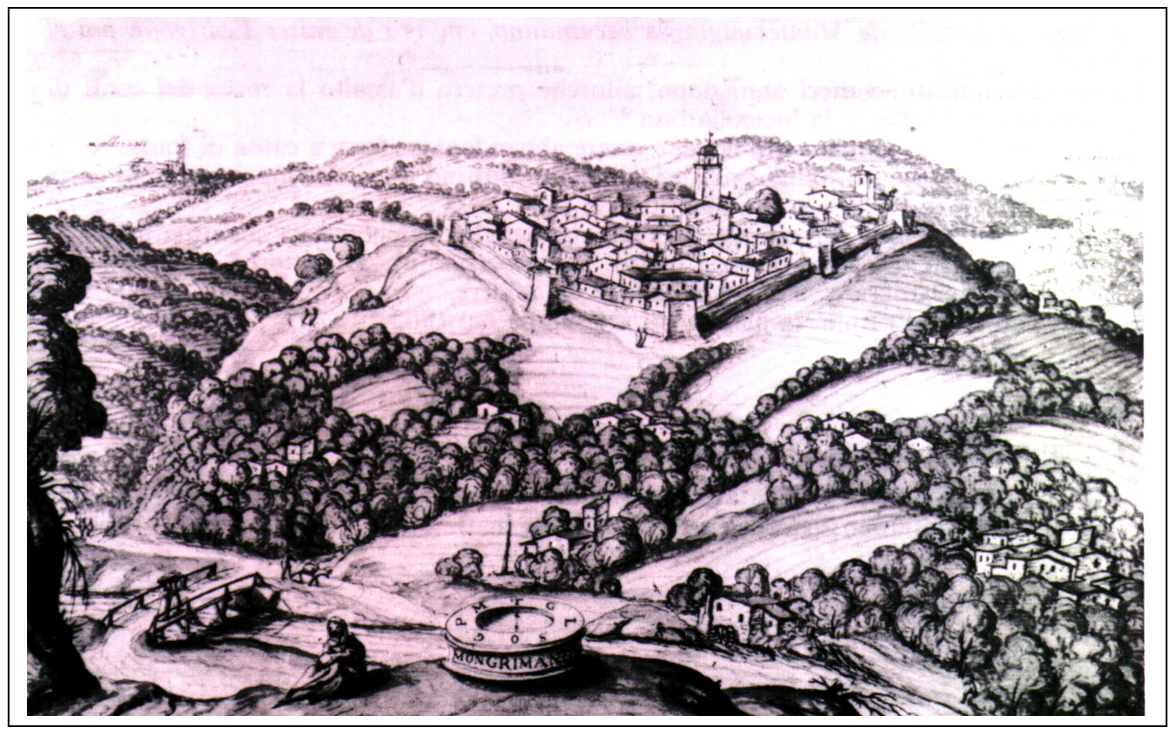
In the 18th century, mounted on the “Porta della Terra” at the entrance to the village, one could still see a stone plaque with the initials of Count Federico and the Imperial Eagle of the Montefeltro family, but the ancient fortress had already lost its appearance, and Monte Grimano looked as it does in the 1626 print by Francesco Mengucci: a settlement clustered tightly around the remaining civic tower.
The walls drawn by Mengucci and much of the settlement, so neatly arranged and orderly, are also partly a product of imagination, because the new houses had been built on top of the original ring of walls, along the “Ghirlandaia,” that is, the street running atop the walls, or immediately at their base. From that time, it was necessary in various sections to construct new retaining and supporting walls. These walls, identified in documents as the village walls, were always subject to restoration and ordinances to protect them from possible tampering, and they are the same walls later reinforced, restored, and completed in the early decades of the 20th century, at the beginning of the Fascist era, and which still exist today.
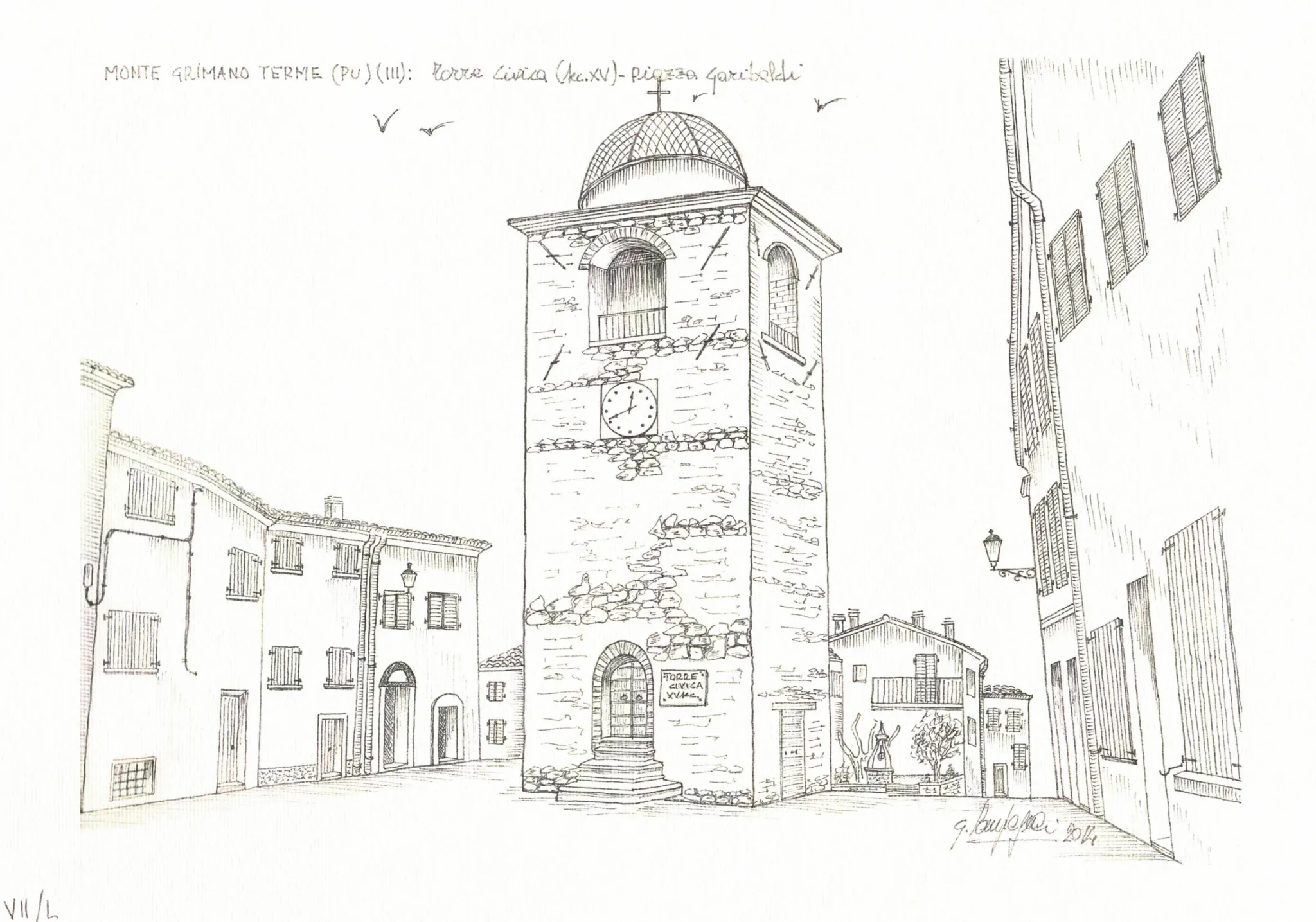
At that time, the embrace of the village with the tower was much tighter than it is today, because the current Vicolo Leopardi extended as far as the middle of today’s Piazza Garibaldi, and all around the tower there were buildings still in use, such as the “Casa dell’Abbondanza” (a true warehouse for public provisions) and the Giampaoli house, with the smaller square behind it.
The demographic changes over the years
The population changes of Monte Grimano over the years give an idea of how things may have developed regarding the urban layout of the historic center.
The population, which in 1371 numbered 90 “fires” (therefore, as mentioned, slightly more or less than 800 people), was recorded as 730 “mouths” in 1501, 827 “souls” in 1627, had dropped to 596 in 1656, and even further to 519 in 1701, before rising again to 591 souls in 1708, 600 in 1736, 719 in 1782, with fluctuations of a few dozen people until returning approximately to the original values at the beginning of the 1800s, with a tendency to increase, reaching 1,041 inhabitants in 1853.
This count does not include Monte Tassi, which experienced much sharper declines before the nineteenth-century recovery, nor Montelicciano, which, being closer to the coast, remained relatively stable at around 200 inhabitants, reaching a maximum of 398 in 1853.
Garibaldi arrives…
During all these years there are no other records of significant events until 1849, when the people of Monte Grimano witnessed Garibaldi’s flight. After the fall of the Roman Republic, pressed by the Austrian army, he was forced to stop right on these hills. The neutrality of the Republic of San Marino did not allow him to continue his escape without compromising the small State’s international relations, but the worsening situation on the ground—after a violent clash between the fugitives and the Austrian army near Monte San Paolo—forced Garibaldi in July 1849 to break off hesitation and head to San Marino with about 1,500 men and 300 horses.
The Birth of the Thermal Baths
In 1889, the mineral water springs located two kilometers from the Historic Center, in the Bagni di Meleto area already known in antiquity, were restored. One should not imagine large or even medium-sized facilities, although on July 22, 1900, it was possible to inaugurate the “Era of Bathing.” An illustrated postcard from 1936 shows, without any doubt, only a hut with the sign “Alcalina,” surrounded by greenery: inside it was the location of the “medicinal” spring.
In any case, the “rediscovery” of the medicinal waters—as they were called at the time—marked the beginning of a new phase of life and development for the town, which equipped itself with inns (for example, the “Appennino” Hotel within the town walls), refreshment points, and entertainment venues.
Acetylene gas lighting replaced oil lamps, and a “perfect postal service” connected Monte Grimano to Rimini in just five hours.
Apart from the exaggerations of writers from past centuries, the reality of Monte Grimano, based on the limited documentation available so far, shows a Montefeltro center that has always been present in history. Its territory, at least in the lower areas, was inhabited by some groups of farmers during Roman times, as scholar Walter Monacchi testifies: just beneath the historic center, at around 300 meters above sea level (not the over 500 meters of the main town), fragments of bricks, stones, and tiles, together with pieces of late imperial pottery, were found, along with traces of a modest rural settlement at a lower altitude, near the former Giovanetti mill.
The statutes of the Vicariate of Monte Grimano (promoted in the 1600s to Podesteria) are among the most complete of the many in Montefeltro: they date back to the 1500s but remained in effect even after the devolution of the Duchy of Urbino to the Church until the late 1700s (one copy preserved in the municipal archive is dated 1641, and another 1787).
Monte Grimano played a driving role relative to the surrounding hamlets and countryside even during the Roman Republic of 1848–49 due to the presence of notaries and legal officials (including Francesco Massaioli, who also served as podestà) and during Napoleonic times.
The Restoration period did not seem overly oppressive, as evidenced by a certain Vico, who appears in the municipal records as a councilor and is commemorated on the only plaque in the parish church of S. Silvestro.
This church, built at the very end of the 18th century in neoclassical style by Cosimo Morelli of Imola, represents, in a sense, the town’s definitive urban arrangement. However, it also marks the beginning of an endless series of small transformations that completely erased the vestiges of the ancient fortress, the early internal walls, and the humble dwellings adapted from medieval structures.
Text by Professor Antonio Di Stefano – All rights reserved
Autore: Municipality of Montegrimano Terme