Culture
Spirituality
Arts and Culture
Itinerary
Tour of the 9 Conventini
A Journey Through Faith and History
Trekking
Throughout the year
Medium
The “Tour of the 9 Conventini” is a fascinating medium-length route that winds through the hinterland of Monte Grimano Terme, following the ancient paths of pilgrims. This itinerary is not just a nature hike, but a true journey through time, touching upon nine significant testimonies of local faith and spirituality.
Ideal for trekking, mountain biking, or gravel cycling, the route connects hidden villages and enchanting corners of the landscape, offering breathtaking views that stretch from gentle hills to tranquil valleys, along ancient medieval roads and trails immersed in greenery.
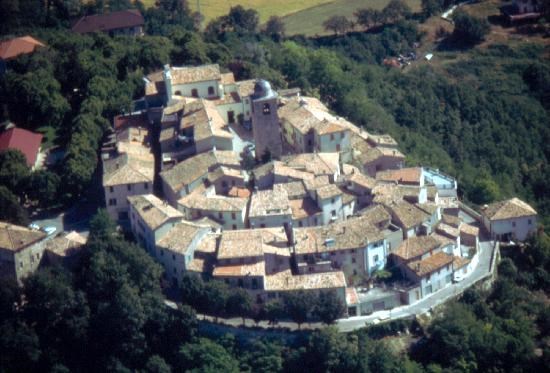
@ LetsMarche.it
Route map
1
Church of Sant’Apollinare
The Silent Guardian of the Agrarian Landscape
The Church of Sant’Apollinare marks the ideal beginning of the pilgrimage. Immersed in a rural and isolated context, it represents one of the oldest testimonies of peasant faith in the area.
Its structure, likely of medieval origin with subsequent renovations, stands out for its essential nature and sober stone facade. Historically, it was a spiritual reference point for the scattered farms, offering travelers a moment of quiet before facing the journey.
The atmosphere here is one of profound tranquility, an evocative prelude to the discovery of the other "small convents" (conventini).
2
Celletta di Meleto
The Votive Shrine Between the Fields and the Ancient Roads
The Celletta di Meleto is a perfect example of minor devotional architecture. It is not a church proper, but a small votive shrine, probably erected in thanks for a grace received or as protection for the farmers working in the surrounding fields. Its presence along an ancient rural road underscores the importance of faith as a companion in travel and work.
These artifacts are often considered the "beating heart" of popular religiosity, preserving simple, sometimes frescoed, sacred images within.
3
Celletta di Ca’Tommassino
The Small Altar on the Road Towards the Valleys
Continuing along the path, the Celletta di Ca’Tommassino presents itself as a further stopping point and place of prayer.
Its strategic location, near ancient farmsteads or road junctions, suggests its function as a spiritual bulwark for those venturing into the valleys. These rural chapels (cellette), often set into the landscape like small treasure chests, bear witness to a time when every step and every agricultural activity was marked by a deep sense of the sacred.
It represents the devotional identity of a community that entrusted its existence to celestial protection.
4
Savignano Church (or Savignano Chapel)
The Welcoming Simplicity of the Smaller Village
The Savignano Church marks the first encounter with a more defined structure central to an established community. Although small in size, this little church has served for generations as the focal point of the spiritual life of the hamlet.
Its essential architecture, typical of country churches, often hides within it a collected atmosphere and precious devotional details.
This stop offers an opportunity to reflect on the role of these small churches, which are true centers of social and religious gathering within a scattered rural landscape.
5
Ruins of the Ancient Dominican Convent
The Majestic Silence of Monastic History
This stop, despite being a ruin, is perhaps the richest in historical charm. The ancient Dominican convent, although in the nearby territory of Montecerignone, was for centuries a center of great spiritual and cultural power, influencing the entire valley.
The remains of the walls and monastic structures tell the story of a life dedicated to prayer, study, and work. Walking among these ruins offers a direct immersion into medieval and Renaissance history, allowing one to imagine the greatness and discipline of the religious orders that shaped the local landscape and faith.
6
Church of Santa Maria Assunta in Savignano
The Liturgical Center and Marian Devotion
This church, dedicated to the Virgin Assunta (Assumption), is the main and most solemn religious building in the hamlet of Savignano. The dedication to Santa Maria Assunta emphasizes a strong and deeply felt Marian devotion, common in many rural communities. Often larger than the previous small church, its architecture reflects local construction canons with a particular focus on liturgical spaces.
It is here that the main festivities take place, representing a true center of identity for the inhabitants.
7
Church of Montetassi
The Belvedere of Faith and Nature
The Church of Montetassi stands out due to its dominant position. Built on a panoramic hill, it is not only a place of worship but a true observation point over the surrounding valley, offering spectacular views that frame the Marche-Romagna landscape.
The choice of the construction site reflects the ancient custom of placing sacred places in elevated positions that lift the spirit, in constant dialogue between human work and the greatness of creation. A stop that unites spiritual and scenic contemplation.
8
Church of Suripe
The Intimacy of the Small Church in an Isolated Village
The Church of Suripe takes us back to the essence of the "small convent": a little church deeply rooted in a rural and perhaps more isolated context. This small church is a gem of simplicity, and its history is closely linked to the events of the few settlements that surround it.
The Church of Suripe, officially named the Church of Our Lady of Suripe (or the Church of Our Lady of Graces), is one of the main historical pilgrimage sites in the Montegrimano Terme area, deeply rooted in the medieval spiritual tradition of Montefeltro.
Its beauty lies in its architectural modesty and the sense of peace it emanates. For the pilgrim, a stop at Suripe is a moment of true tranquility, a prelude to the return to the main settlement.
The Church of Suripe remains a place where medieval religious history, the hiking trails of Montefeltro, and popular devotion meet, offering visitors an experience of immersion in the spiritual and landscape heritage of Montegrimano Terme.
9
Church of San Silvestro in Monte Grimano Terme
The Majestic Seal of the Itinerary in the Historic Village
The route concludes with the Church of San Silvestro, the most significant religious building located in the heart of the historic center of Monte Grimano Terme. Its grandeur and centuries-old history reflect its status as the mother church of the community.
The structure, which has undergone various transformations over time, preserves works of art and historical testimonies that narrate the life of the village. Arriving here is not just the end of the physical journey, but the completion of a spiritual and cultural voyage through the religious and popular history of the territory.